
“The greatest advantage will belong to people who understand both their field and how to use AI. Lawyers, salespeople, marketers, and managers who know how to work with AI will have an edge,” says Michal Gregor, founder of Productivity Upgrade.
The key is not to compete with AI, but to learn how to collaborate with it. Working with AI should expand your capabilities and accelerate your productivity.
As technology takes over routine and repetitive tasks, uniquely human qualities will become even more valuable—trust, empathy, creativity, judgment, and the ability to work with others. “The most successful professionals will be those who keep learning, adapt to change, and combine technology with human skills,” Gregor says.
In other words, simply knowing how to use AI tools such as ChatGPT and write a few prompts will not be enough. Success will come from building effective AI workflows: delegating the right tasks, providing sufficient context, reviewing the output, and refining the process based on feedback. The goal is to create a system that becomes more useful over time, while the human remains in control and retains ultimate responsibility for the results.
This suggests that the future may turn out very differently from what many people fear. Rather than an apocalyptic scenario, we are more likely to see another demonstration of human adaptability.
Warnings about mass unemployment are also beginning to soften. Even some technology leaders who previously predicted dramatic job losses are now revising their expectations.
OpenAI CEO Sam Altman recently acknowledged that he had overestimated how quickly AI would eliminate office jobs. “I’m delighted to be wrong about this,” Altman said, adding that he had expected more entry-level white-collar positions to have disappeared by now.
He also pointed to something that AI has so far struggled to replace: genuine human interaction. After experimenting with using AI to respond to messages, Altman found that people still valued knowing they were communicating directly with another person.
A similar development can be seen at Anthropic, although its CEO, Dario Amodei, remains more cautious. In May 2025, he warned that AI could eliminate half of all entry-level white-collar jobs and push unemployment as high as 10–20% within one to five years.
More recently, however, Amodei has emphasized that companies face a choice. They can use AI to perform the same amount of work with fewer people—or use it to accomplish far more with the same workforce. The second possibility resembles the so-called Jevons paradox: as a technology becomes cheaper and more efficient, demand for what it produces may increase rather than decline.
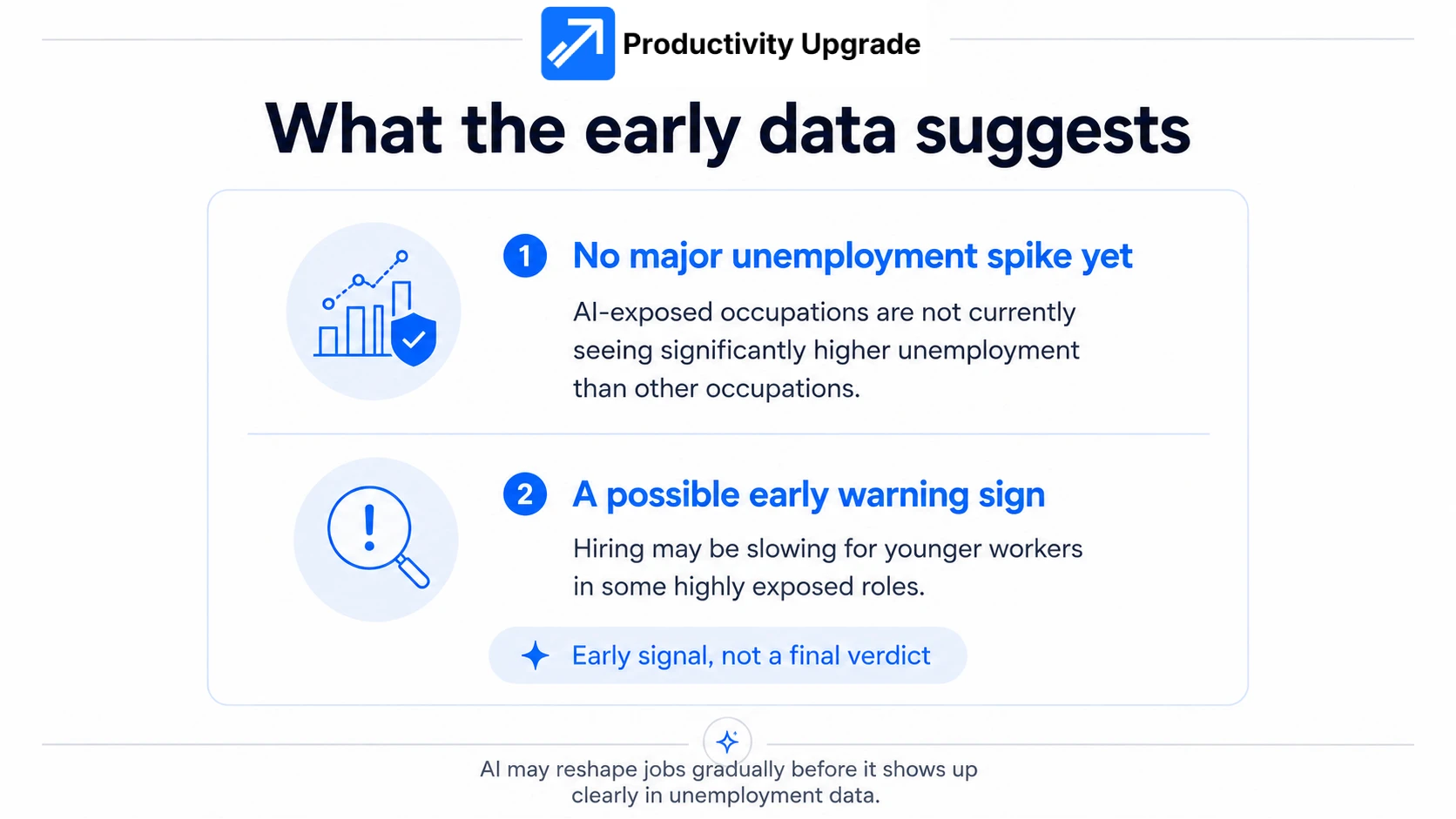
Anthropic’s own research offers some early evidence that widespread displacement has not yet materialized. A study combining theoretical AI capabilities, real-world Claude usage, and US labor-market data found no systematic increase in unemployment among workers in the occupations most exposed to AI.
The findings are not entirely reassuring. Anthropic also found tentative evidence that hiring of workers aged 22–25 into highly exposed occupations has slowed. AI may therefore affect entry-level opportunities before it produces a visible rise in unemployment.
The key takeaway from the AI revolution may therefore be different from what many in the technology sector expected only recently. Jobs are not disappearing overnight—they are evolving. AI is reshaping the structure of work and shifting value toward expertise, creativity, responsibility, judgment, and human interaction.
Perhaps the greatest surprise of this technological wave will be that the most difficult thing to replace is precisely the human element that remains at the heart of the economy.